Rich Bontrager on Stuttering, Speaking and Finding His Voice
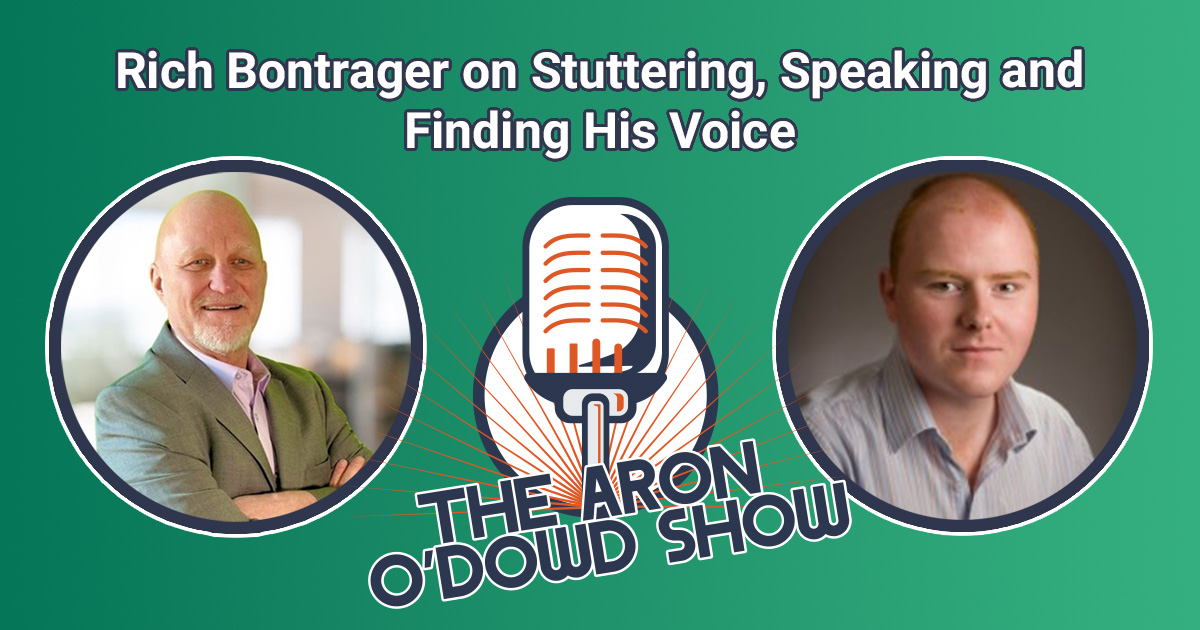
Rich “Trigger” Bontrager joins Aron O’Dowd for a moving conversation about stuttering, disability, public speaking, faith, broadcasting and what it really means to find your voice.
For Rich, stuttering is not something that disappears. It is something he manages. Early in the conversation, he explains that there is no pill, no injection and no simple cure for stuttering. Instead, his life has been shaped by learning to slow down, breathe and give himself the space to speak.
That idea runs through the whole episode of The Aron O’Dowd Show. Rich’s story is not just about speech. It is about being misunderstood, learning resilience, using creativity to communicate and discovering that the very thing that once felt like a barrier can become a bridge to other people.
Learning to slow down and breathe
When Aron asks Rich what he has learned from living with disability and different ability, Rich’s answer is simple and powerful: slow down and breathe.
For someone who stutters, speech can become a physical and mental challenge at the same time. Rich describes how certain words can lock in the body, especially when he is trying to say his own name. He explains that, as a child, he could barely speak a full sentence. Introducing himself was especially difficult because names are often among the hardest words for people who stutter.
That experience affected how others saw him. Teachers and classmates sometimes misunderstood what was happening. At times, he was treated as though he was slow or unable, when the reality was that he knew what he wanted to say but could not always get the words out in the way others expected.
Rich’s lesson is a useful one for anyone facing pressure, not just people who stutter. When we are allowed to slow down, breathe and gather ourselves, we can often move through situations that otherwise feel impossible.
Growing up misunderstood
Rich speaks honestly about the shame and frustration that can come from being different in a world that wants quick answers and smooth communication.
A stutter can make everyday moments feel loaded. A simple introduction, a classroom answer or a social exchange can become a moment of fear. For Rich, this meant growing up with a constant awareness of how he sounded to other people.
Yet the conversation does not stay in the pain of those experiences. Rich also talks about the process of becoming more comfortable with his stutter as an adult. That does not mean pretending it is not there. It means accepting it as part of his story, learning how to manage it and refusing to let it define the limits of his life.
There is a difference between hiding a struggle and integrating it. Rich’s journey shows the importance of moving from shame to ownership.
Creativity as a way through
One of the most interesting parts of the conversation is Rich’s discussion of performance, voice and persona.
He talks about how creative expression helped unlock parts of his communication. Character voices, preaching, broadcasting, comic books and storytelling all become part of the way he finds rhythm and freedom in speech. When he steps into a role, tells a story or uses a different voice, communication can sometimes flow in a way that ordinary speech does not.
This does not mean the stutter disappears. Rich is clear that it is always there. But creativity gives him tools. It gives him routes around the blocks. It allows him to express meaning, emotion and personality even when speech itself is difficult.
That is one of the strongest messages in the episode: people often find their path not by removing the challenge, but by discovering new ways to work with it.
Broadcasting with a stutter
Rich’s work in media and broadcasting gives the episode an especially compelling edge.
Public speaking is one of the most common fears for many people. For someone with a lifelong stutter, the idea of broadcasting or speaking publicly might seem impossible from the outside. Rich’s life challenges that assumption.
He speaks about managing his stutter in broadcasting and public speaking, and about the importance of preparation, rhythm and presence. He also discusses how his struggles help him connect with other people. When someone has lived through difficulty, that experience can create trust. It can make them more able to sit with another person’s pain without judgement.
Rich’s communication is not powerful because it is flawless. It is powerful because it is honest.
Faith, empathy and purpose
Faith also plays a role in Rich’s story. He talks about ministry, preaching and the way his own struggles have shaped his ability to build trust.
There is a humility in the way Rich describes his journey. He does not present disability as something neatly solved. Instead, he speaks about learning, adapting and using the story he has been given. His bad eyesight and hearing loss are also part of this wider conversation about living with difference, building empathy and helping others feel less alone.
For Aron, this is exactly the kind of story The Aron O’Dowd Show is built around: a person facing real barriers and choosing to live with meaning, energy and purpose.
Turning difficulty into connection
By the end of the episode, Rich’s story becomes less about stuttering alone and more about what happens when someone refuses to let a challenge close down their life.
He has turned disability into empathy. He has turned public speaking fear into a broadcasting career. He has turned the difficulty of finding words into a deeper appreciation for story, breath and presence.
That does not make the journey easy. But it does make it meaningful.
Rich Bontrager’s conversation with Aron O’Dowd is a reminder that finding your voice is not always about speaking perfectly. Sometimes it is about speaking honestly, slowly, courageously and in your own way.
Watch the episode
Watch Rich Bontrager on The Aron O’Dowd Show:
View more interviews like this on the Aron O’Dowd Show on YouTube